
Call Us: +27 11 043 0153
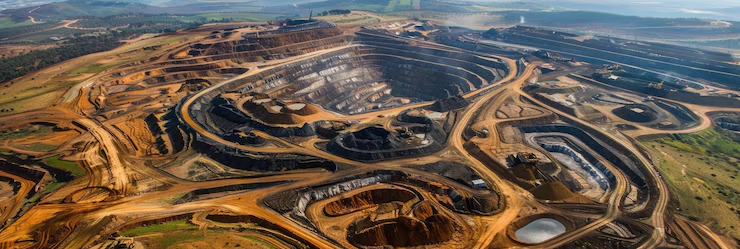
Mining is the silent engine of the modern world. Without it, we wouldn’t have the copper for our electrical grids, the lithium for our batteries, or the steel for our cities. However, a mine isn’t just a hole in the ground; it is a highly engineered, long-term project that spans decades.
I. The Discovery Phase (Prospecting & Exploration)
Everything begins with a “hint” in the dirt. Geologists look for specific signatures in the landscape that suggest valuable minerals are hiding beneath the surface.
- Geochemical Sampling: Testing soil and water for trace elements.
- Geophysical Surveys: Using drones or planes to measure magnetic and gravitational anomalies.
- Core Drilling: The “moment of truth.” Specialized drills pull long, cylindrical samples of rock from deep underground to see exactly what’s there and how concentrated it is.
II. Designing the Operation
Once a deposit is confirmed, engineers must decide on the “geometry” of the mine. This is usually dictated by how deep the ore sits.
- Open-Pit Mining: If the ore is near the surface, the “overburden” (the dirt on top) is stripped away to create a massive, terraced bowl.
- Underground Mining: If the ore is deep or follows a thin vein, miners sink vertical shafts and horizontal tunnels to reach it directly, minimizing the footprint on the surface.
III. The Extraction Cycle
The actual day-to-day work of mining is a rhythmic cycle designed for maximum efficiency and safety.
- Drilling & Blasting: Engineers map out a “blast pattern.” Small holes are drilled, filled with explosives, and detonated to break the solid rock into manageable rubble.
- Load & Haul: Massive machinery—loaders and haul trucks—move the broken rock to the surface. Some of these trucks are as tall as a two-story house!
- Crushing: The raw rock is fed into a primary crusher to reduce it to the size of gravel before it heads to the processing plant.
IV. Processing: Separating the Treasure from the Trash
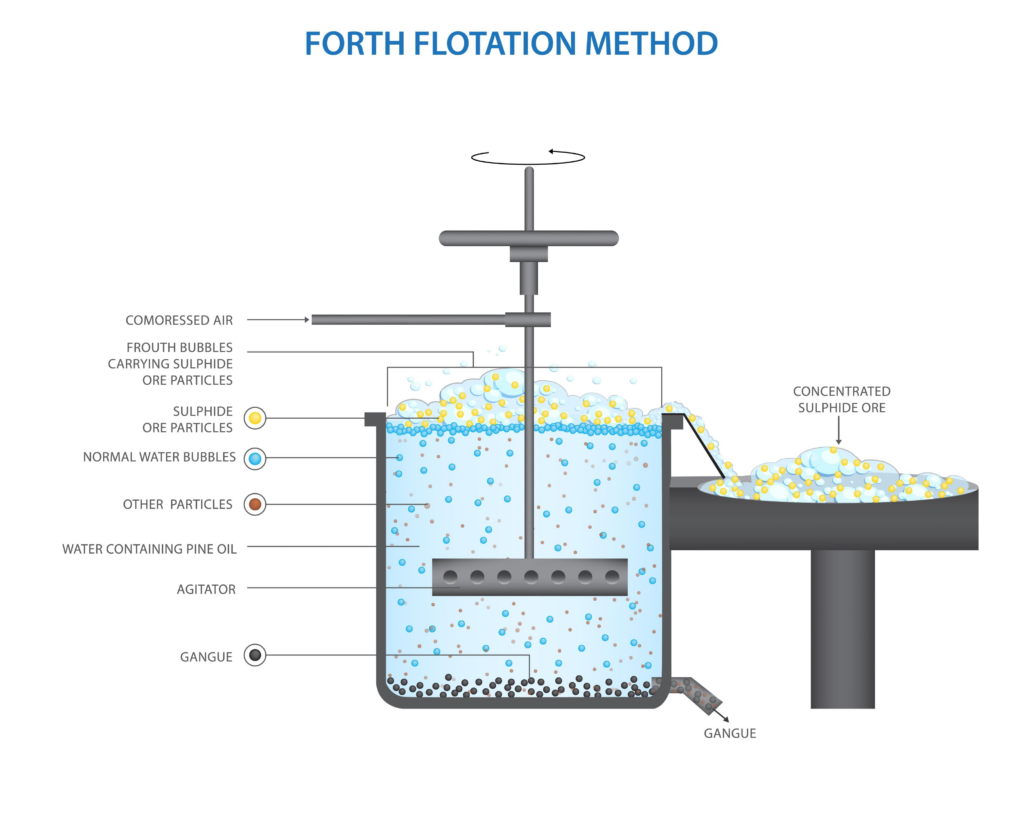
The rock that comes out of the ground isn’t pure metal; it’s a mix of valuable minerals and “waste” rock (gangue).
- Milling: The rock is ground into a powder as fine as flour.
- Froth Flotation: In many metal mines, the powder is mixed with water and chemicals in a tank. Air is bubbled through, and the valuable minerals “stick” to the bubbles and float to the top like soap suds, while the waste sinks.
- Smelting & Refining: The concentrated material is then melted at extreme temperatures to remove final impurities, resulting in nearly pure metal.
V. Environmental Stewardship and Reclamation
In the past, mines were often abandoned once the ore ran out. Today, Reclamation is a legal and ethical requirement that begins even before the mine opens.
- Tailings Management: The leftover waste “slurry” is stored in highly engineered facilities to ensure it doesn’t leak into the water table.
- Land Restoration: Once the mine is closed, the land is reshaped, topsoil is replaced, and native species are replanted. The goal is to leave the site as a park, a forest, or a functional piece of land for the community.
The Bottom Line
Mining is a high-stakes balance of chemistry, geology, and heavy machinery. It is an invasive process, but with modern technology and strict reclamation laws, it is the essential first step in the lifecycle of almost every product we touch.
Are you looking to use this for a school project, or are you interested in the investment side of how these mines get funded?